
Running a small agency is kind of like conducting an intricate orchestra. Each of your clients represents a different instrument, with their As the leader of a creative agency, what are the things that keep you up at night? Is it nailing the next big campaign? Or maybe trying to keep your many, many clients happy, engaged, and coming back for more? Don’t worry. You’re not the only one. Client satisfaction and retention are both the beating heart and headache of creative agency life. And according to Function Point’s 2025 Industry Report, the challenge is as fierce as ever.
Let’s break down what the data we gathered for you tells us about client loyalty, why so many agencies are losing out, and how you can be the one creative agency that clients never want to leave.
65% of Agencies Lose Clients to In-House Teams—Why?
Here’s the stat that really raised our eyebrows when we pulled and analyzed the industry report data. 65% of the creative agencies we surveyed reported losing clients, not due to poor service or bad work, but because those clients moved their creative operations in-house.
WHAT IS THE #1 REASON THAT CLIENTS STOP USING YOUR SERVICES?
*44% of total agencies answered
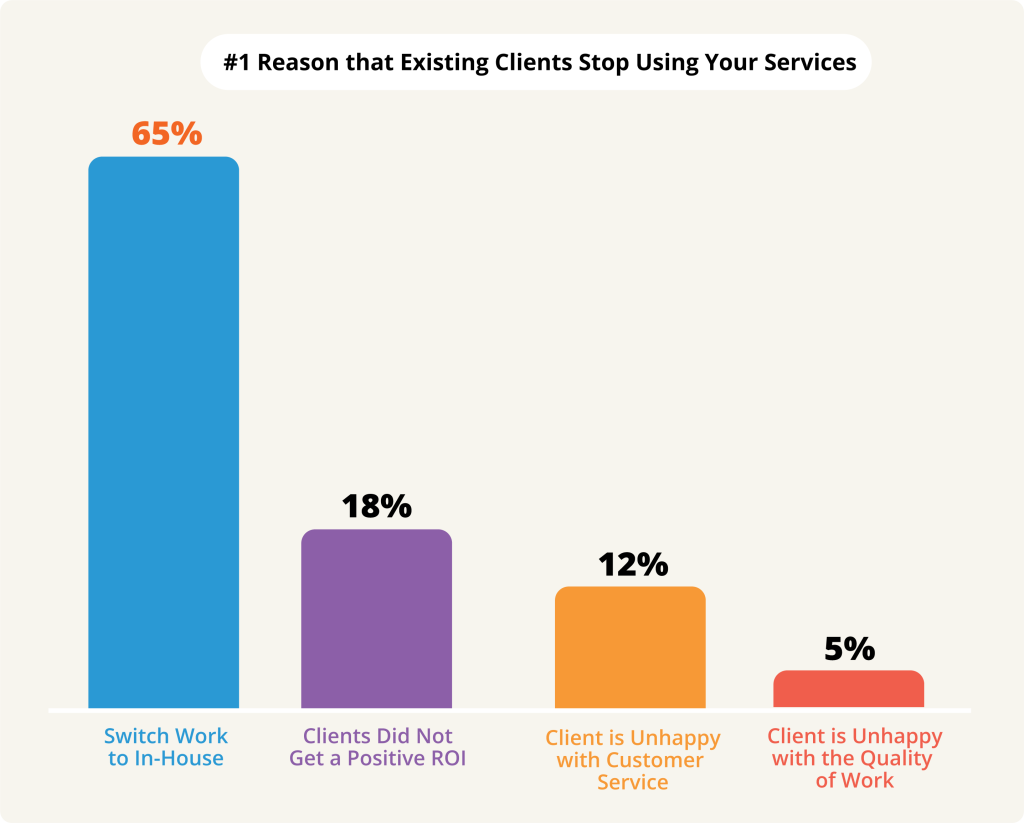
Let that sink in.
So it’s not failure on the agency’s part. It really comes down to perceived value.
As clients become more cost-conscious—and as we’ve all experienced here, marketing and creative content tends to get cut first—and build internal teams powered by advanced tools (including AI), they start asking themselves some hard questions:

- Can we do this ourselves faster?
- Do we really need to pay an agency retainer?
- Are we seeing measurable ROI?
Woof. These can sometimes have answers that favour insourcing. Which means you, the creative agency, lose out. Even when you’re doing great work.
Again, it’s not that the client is dissatisfied with their agency. What they’re looking for is more control and faster turnaround times. Oh, and for perceived cost savings.
But here’s the cost they don’t entirely consider when thinking about moving in-house for their creative work: the cost of creative and strategic thinking.
Guess what? This is where you have a major edge. But you have to be able to communicate and prove your value.
- Can you do it efficiently and take the workload off them?
- Can they really afford not to pay you? Show them they can’t.
- Can you guarantee them measurable ROI? Or backup with case studies or their own metrics?
The Top Reasons Clients Stay Loyal (Quality, ROI, Expertise)
That was fun, wasn’t it? Kidding. Let’s actually now take a look at the good news. The same report also shows that 53% of clients stick with their agency because of the quality of work.
WHAT IS THE #1 REASON THAT EXISTING CLIENTS CONTINUE TO USE YOUR SERVICES?
*57% of total agencies answered
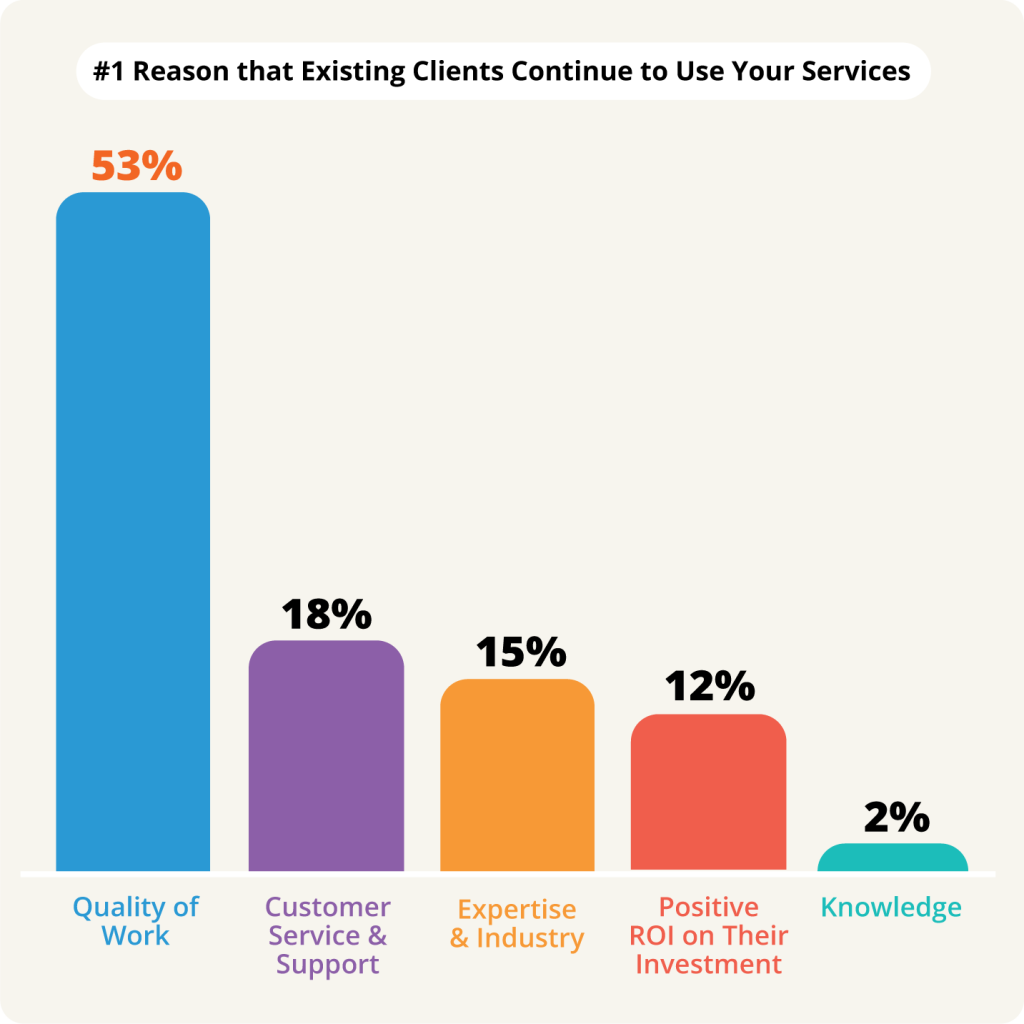
That’s huge! Even though we live in a world where there are endless AI tools, Canva templates, and drag-and-drop web builders, craft still matters. Creative agencies that consistently deliver polished, creative, effective work retain their clients more often. And have the foundation for pushing back when those clients try to cut down on costs and try the old do-it-yourself method.
But it’s not just quality. Here are the other top reasons clients keep coming back:
- Customer service & support (18%) – Responsive communication, fast turnarounds, and a human touch go a long way. These creative agencies are answering emails promptly and solving problems efficiently. They’re actually showing genuine care for their clients’ success. This means that, even when things are tough, their clients are likely to stick with them for the long haul.
- Expertise and industry knowledge (15%) – Clients value teams who “get” their niche and can bring unique insights to the table. These agencies are bringing experience and strategic thinking to their clients. They’re showing that they have a deep understanding of their client’s industry, and that tells their clients that they are invaluable.
- Positive ROI (12%) – If the work is clearly driving results, clients are far less likely to walk away. These agencies are making sure leads are turning to conversions and then turning to revenue. Their clients don’t think twice about renewing their contracts or even increasing their budgets.
Now that we’ve reviewed all that data, let’s summarize. Clients stay when they feel seen, heard, and successful.
This is crucial information when it comes to making sure your agency keeps your clients. Make sure you communicate clearly, measure their campaign success transparently, and even go the extra mile if you want to keep your contracts alive and well.
How Agencies Are Measuring and Improving Client Satisfaction
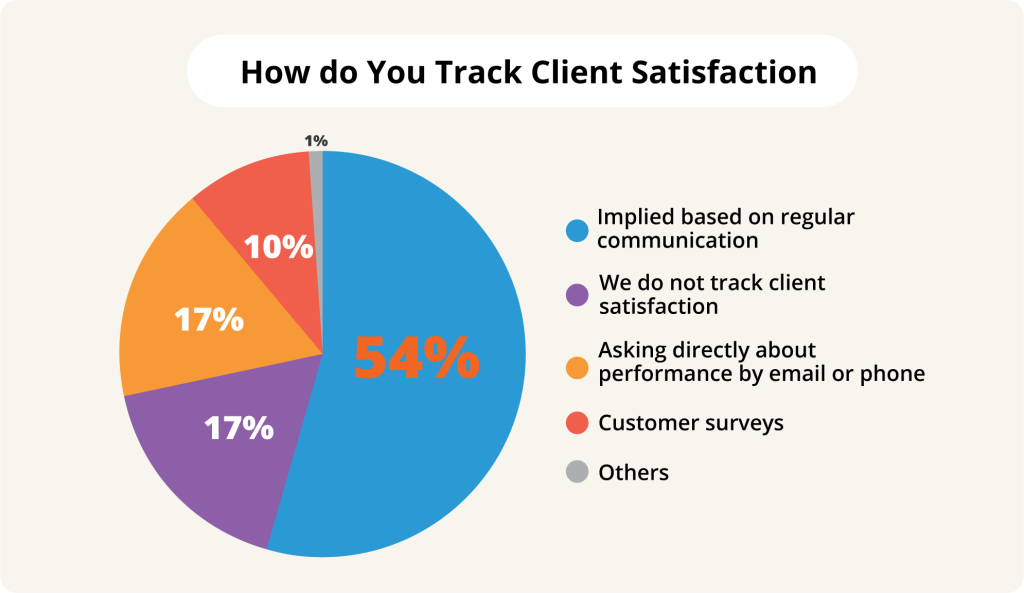
So you want to keep your clients happy—but how do you know if you’re actually doing that? Well, as it turns out, 17% of agencies don’t track client satisfaction at all. So don’t feel too bad if you’re one of those agencies – you’re not alone. However, this has to change. Because that’s like flying blind in a storm. And flying blind is hard enough as it is.
Here’s how the rest of the industry is measuring its success:
- 54% rely on regular communication in order to gauge satisfaction. This includes things like check-ins and progress updates.
- 17% ask directly via email or phone.
- 10% use client surveys in order to get more structured feedback.
HOW DO YOU TRACK CLIENT SATISFACTION?
*57% of total agencies answered
But you can’t just rely on measurement alone. That’s only part of the equation. Don’t just check the boxes that you’ve done these things. Once you gather the feedback from your clients, use that to refine your processes and improve your deliverables. This helps you build much stronger relationships with your clients.
And improving satisfaction with clients means you have to set some clear expectations up front with your clients, and then make sure you’re holding them (and your team) to those expectations. If you, your client, and your team aren’t matched in expectations, then you’re well on the quickest way to disappointing your client… and showing them reasons to churn.
Here are some of the techniques creative agencies used in 2024 to help set and understand their clients’ expectations:
WHAT TECHNIQUES HAVE HELPED YOU BETTER SET/UNDERSTAND CLIENT EXPECTATIONS?
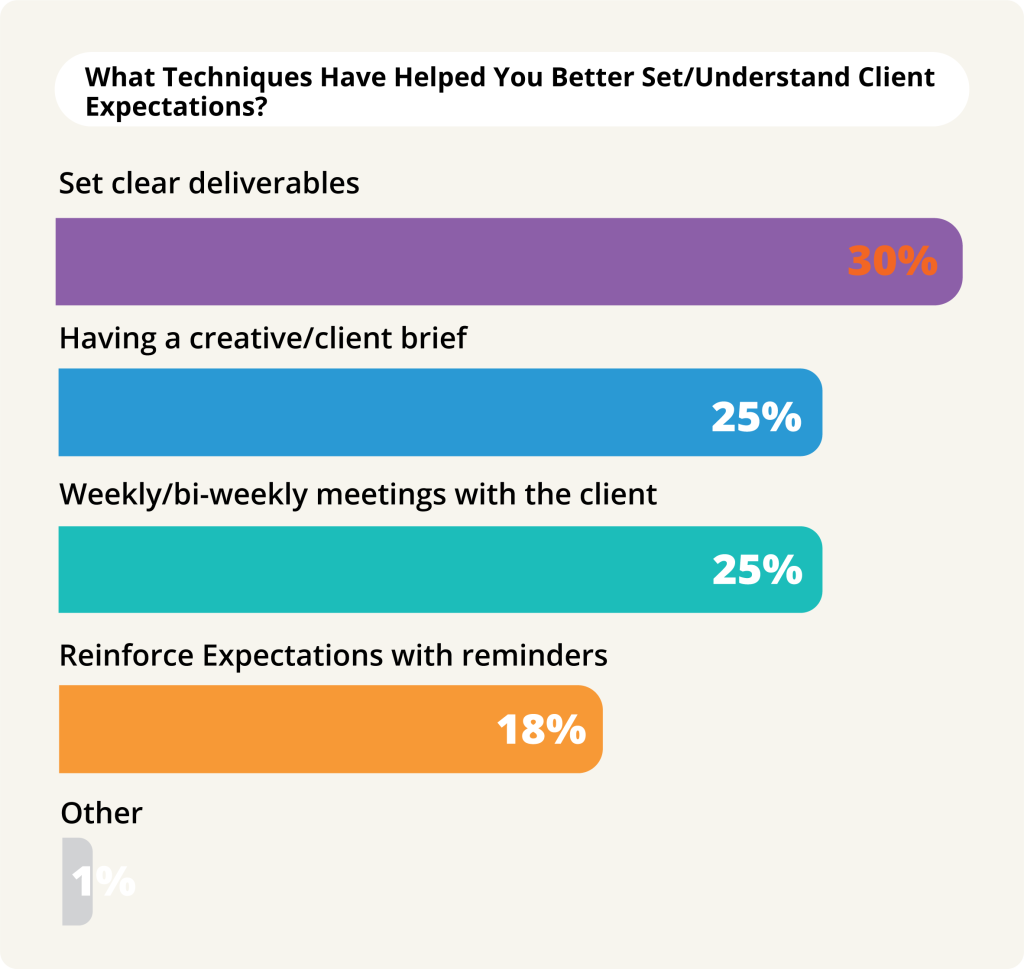
Now, while these aren’t necessarily glamorous solutions, they’re very effective.
But at the end of the day—and let’s be honest—sometimes the best way to improve satisfaction is simply to ask:
“How’s it going? Is this still working for you? If not, what isn’t?”
This one question can very quickly uncover everything from minor frustrations to major misalignments. Which means you now have the chance to fix those frustrations and misalignments before your client decides to go that DIY route. Remember, the trick is to show and communicate value.
Over-Servicing vs. Under-Servicing: Finding the Balance
Ah, yes, the age-old creative agency dilemma. Do we do too much and lose money? Or do we do too little and lose the client? Where’s the happy medium?!
According to the 2025 Industry Report, 79% of creative agencies are over-servicing clients, and unfortunately, they’re not always billing for it.
ARE YOU REGULARLY OVER-SERVICING CLIENTS?
*57% of total agencies answered
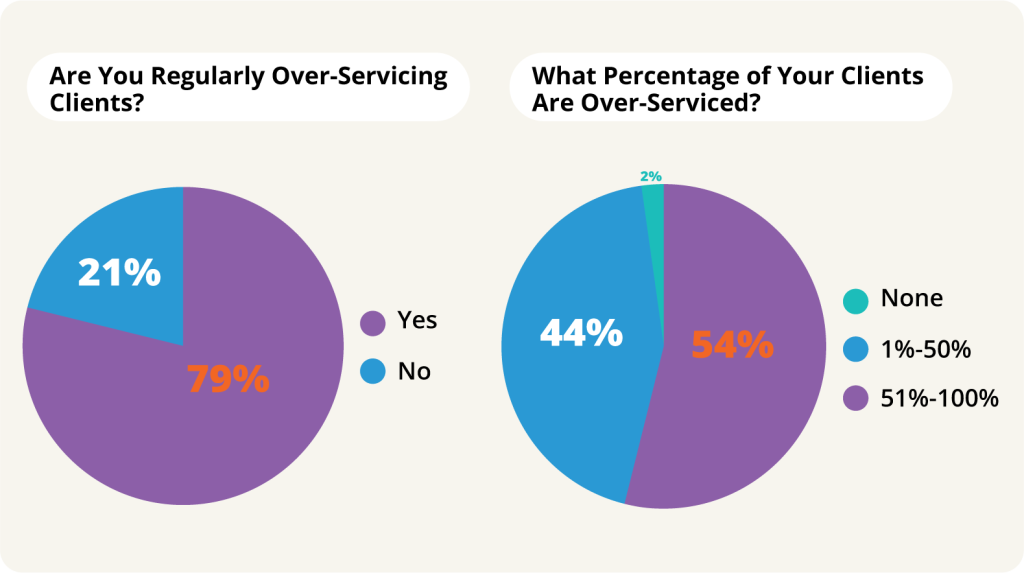
That means nearly 8 out of 10 agencies are doing unpaid work, likely due to:
- Poorly defined scopes
- Fear of client pushback
- Shifting project demands
- Just wanting to be helpful
We even asked what the percentage of their clients was being over-serviced, and that number is also shocking. 54% of agencies said that over 50% of their clients were being over-serviced.
WHAT PERCENTAGE OF YOUR CLIENTS ARE OVER-SERVICED?
Sound like you?
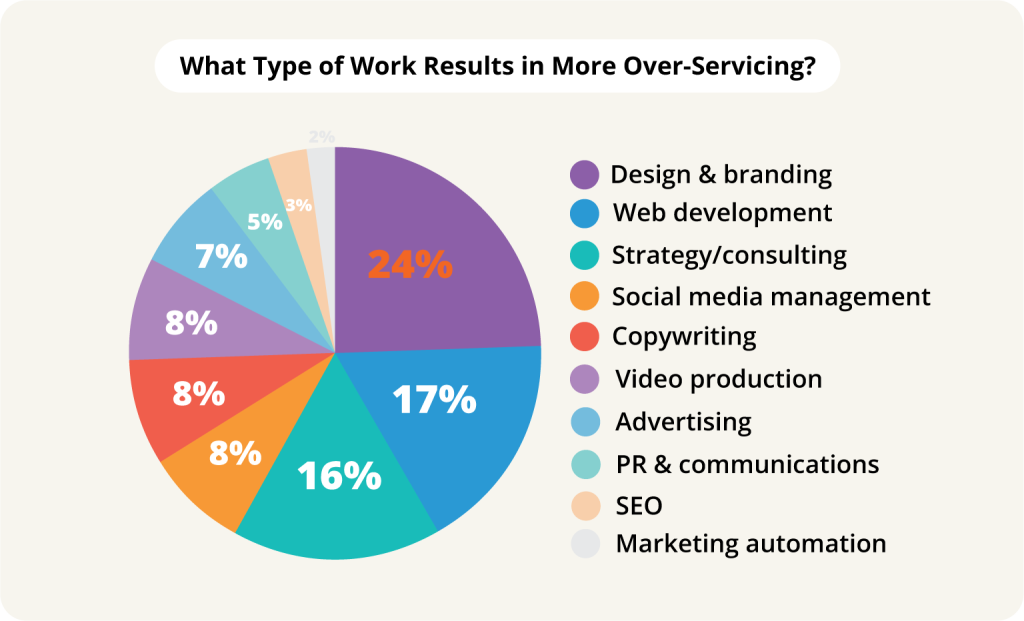
Let’s now take a look at some of the most common over-serviced work.
- Design & Branding (24%) – surprising nobody.
- Strategy & Consulting (16%)
- Web Development (17%)
WHAT TYPE OF WORK RESULTS IN MORE OVER-SERVICING?
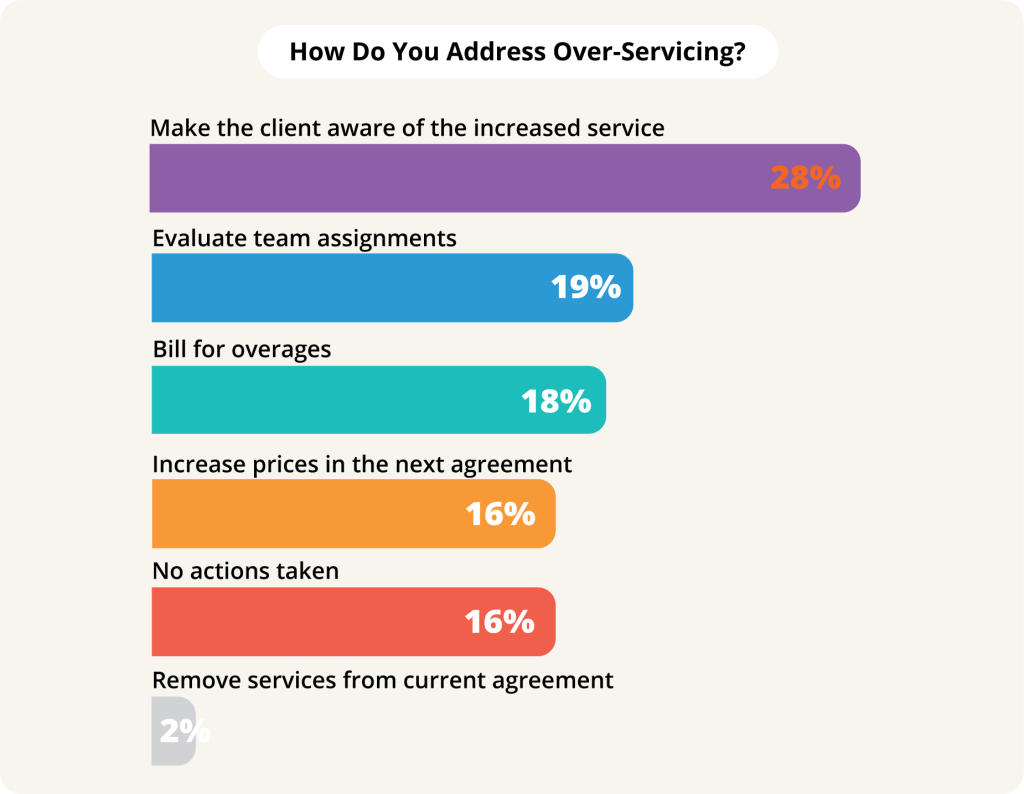
So how are creative agencies dealing with this? Here’s how our survey respondents are addressing over-servicing:
- 28% make the client aware of the increased service
- 19% reevaluate team assignments
- 18% bill for overages
- 16% raise pin rices in future agreements
Interestingly, 16% of agencies take no action at all. This is a recipe for burnout and shrinking margins. Eesh.
HOW DO YOU ADDRESS OVER-SERVICING?
So what’s our lesson? Set clear boundaries. Build flexibility into your contracts. And when the scope changes, have the conversation. Transparency preserves relationships and your bottom line.
Tools and Strategies to Strengthen Long-Term Client Relationships
If you want your clients to stay, you’re going to have to play the long game. That means you’ll need to focus on building trust and delivering consistently. You’ll need to stay in sync with your clients and your team on expectations. The 2025 Industry Report data offers some smart strategies for doing just that. Let’s summarize.
- Set Expectations Early and Revisit Them Often
Remember above when we spoke about the techniques used to better understand and set client expectations? Use that! Build creative briefs and establish weekly or biweekly meetings with your clients. Set clear deliverables with them (nothing vague!) and make sure you’re giving them reminders that reinforce expectations.
- Avoid Surprises With Scope & Pricing Transparency
Frequent scope changes and misaligned expectations are always major pain points. The agencies that successfully retain clients tend to outline project boundaries in detail. They also flag scope creep early and use reminders and documentation that reinforce agreements.
- Track Client Happiness—Don’t Assume It
While implied satisfaction based on regular communication is the most common tracking method, it’s not always enough. Structured feedback (even those informal check-ins) gives you the data you need to course-correct before your client tries to ghost you.
- Be Proactive About Over-Servicing
Rather than silently doing more work than you’re being paid for, consider a few things first. Maybe include flex hours or buffers in your retainers. Or maybe be more up-front about when work exceeds scope. But the most important thing is to create a culture of scope awareness within your team.
- Use Tools That Support Better Service
Modern project management platforms help with creating clear deliverables and timelines. Some might even have client communication logs and time tracking. Make sure you’re tracking your time, because it’s a key indicator of over-servicing.
Use tools like Function Point that include integrated project, time, and client management.
Relationships Over Transactions
At the end of the day, client satisfaction and retention come down to one word: relationship. You’re not just delivering great creative work. You need to create an experience with your clients. Build an ongoing partnership with them that feels responsive, strategic, and supportive.
Creative agencies that invest in that experience—remember, the ones who communicate clearly, set boundaries, and deliver consistently—are the ones that survive the churn.
Make yourself indispensable to your clients. Communicate to them the value they’re getting out of working with you. And don’t just communicate that—show it! They need to witness your value in action.
Need help strengthening your client communication and retention processes? Reach out to FunctionFox today to learn how we can help you make your agency the one clients never want to leave.