
If you’re running a small creative agency, there’s a pretty good chance you’re wearing more hats than you’d like to admit—you’re the project manager, the creative director, the sales lead, HR… and probably even the office therapist. But no matter what hat or fake mustache you’re wearing, there’s always one challenge that consistently gets in your way: growing revenue.

According to the FunctionFox 2025 Industry Report, 58% of agency owners say that growing and maintaining revenue is the #1 challenge they face on a daily basis. And for small agencies, that challenge is amplified by tight margins, lean teams, and the constant juggle between doing the work and bringing in the work.
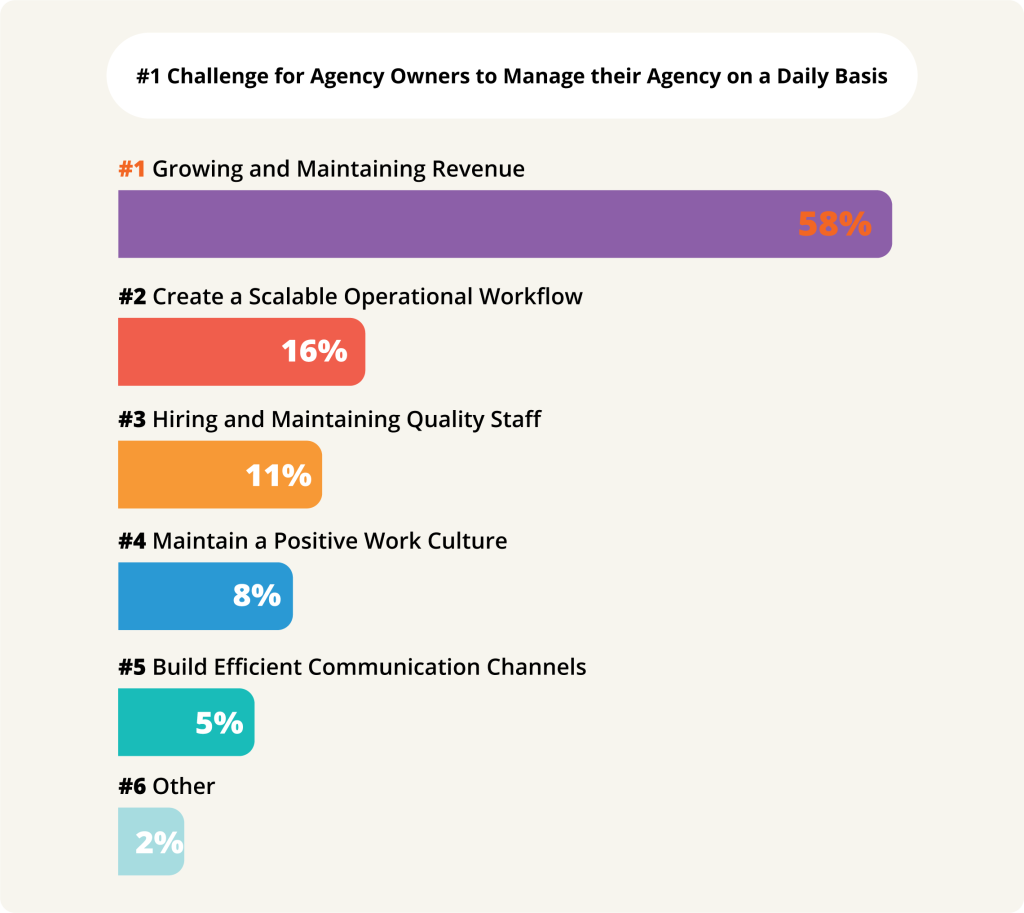
So what makes revenue growth so tricky? You’re not just having to find new clients. You’ve also got to find the right clients and price your services strategically. And then you’ve got to keep those clients happy. All while doing it without burning out your team or sacrificing the quality of your creative work.
But we’re here to help! Let’s take a look at why revenue growth is such a persistent hurdle—and what small agencies can actually do about it.
Why Revenue Growth Is So Hard for Small Agencies
First, let’s be clear: small agencies are not underperforming because they don’t have the talent or the vision. Honestly, the opposite is true. Small agencies have to punch well above their weight. They’ve got to deliver their exceptional work with tighter teams and fewer resources. So that means there are a ton of challenges.
- Market Saturation
Let’s start with the obvious. There are a lot of creative agencies out there. Then there’s freelancers, AI tools, and in-house teams. These are increasingly picking up creative slack, which is making it harder than ever to stand out. Clients have more options, and too many of them are hunting for cheaper, faster solutions—even if they come at the cost of quality.
- In-House Competition
The industry report shows that 65% of agencies lost clients to in-house teams. This isn’t a reflection of poor agency performance. It’s actually a sign of shifting priorities. Companies are increasingly trying to cut costs, and the first thing that always gets cut is marketing and advertising. So they start building internal creative departments, even if the work quality suffers. For small agencies, you’re forced to fight an uphill battle while going up a creek without a paddle and walking through two feet of snow with no shoes both ways in order to constantly prove your value.
- Over-Servicing Without Compensation
Here’s a stat that should give every agency owner pause: 79% of agencies admit to over-servicing clients without proper compensation. Oof. If your margins are already thin, giving away extra hours and work is putting yourself in that canoe with no paddle and taking away your only pair of boots. We get it. As a small team, you feel more of that pressure to “wow” your clients to keep their business. But too often, that results in burning out your staff and undercutting your profitability.
ARE YOU REGULARLY OVER-SERVICING CLIENTS?
*57% of total agencies answered
| No | 21% |
| Yes | 79% |
- Lack of Sales & Marketing Infrastructure
In small agencies, the same person leading strategy or design is probably also in charge of pitching, selling, invoicing, and client onboarding. This fragmented workflow makes it incredibly difficult to build a steady, predictable sales pipeline. Most small agencies don’t have a dedicated sales rep or a marketing funnel. You might be relying on referrals and word-of-mouth. That works… until it doesn’t.
- Fear of Raising Prices
Many small agency owners are afraid to raise their prices, worried it will drive clients away. But as the 2025 data shows, price increases were a far less successful revenue strategy in 2024 (20%) compared to 2023 (61%). And that’s largely because they weren’t paired with a clear value narrative. The problem isn’t always the price. It’s how (and whether) the value behind that price is communicated.
So yeah, as a small creative agency, the world can absolutely be working against you (and sometimes it’s you…). No wonder revenue growth feels like climbing Everest in flip-flops.
But don’t worry. There are ways forward. Next we’re going to dig into the actual levers of revenue growth and how to start pulling them intentionally.
Understanding the Revenue Equation
Before you can scale your agency’s revenue, you need to understand the levers you actually control. As much as it sucks, revenue growth is math, not magic. But as with all math, that math can get messy when you’re calculating client expectations, scope creep, billable hours, and your own team’s capacity.
So let’s simplify it. At its core, revenue is driven by four main variables:
- Pricing
How much are you charging for your work? Are your rates aligned with the value you provide—or with what you think your clients are willing to pay? Many small agencies default to hourly pricing without realizing they’re undercharging for their high-impact services. If your rates don’t reflect your strategic expertise, your revenue is capped no matter how many hours you work.
- Client Acquisition
Are you consistently bringing in new business? We’re not talking about random leads, but those ideal clients—the ones who understand your value, respect your boundaries, and pay your rates.
- Client Retention
Are you keeping the clients you already have? Acquiring a new client can cost five times more than keeping an existing one. Retention is one of the most overlooked (and most profitable) paths to revenue growth.
- Service Delivery Efficiency
Are you delivering your work profitably? This includes everything from scope management to project timelines to billable utilization. If your team is working at 60% billable hours, or if you’re constantly over-delivering without charging more, you’re just leaving revenue on the table.
Shifts in Strategy: What Used to Work vs. What Works Now
Let’s talk numbers. The 2025 Industry Report offers some pretty eye-opening insights into how agency strategies for growth have evolved—and what’s falling flat.
Here’s a comparison of revenue growth strategies in 2023 vs. 2024:
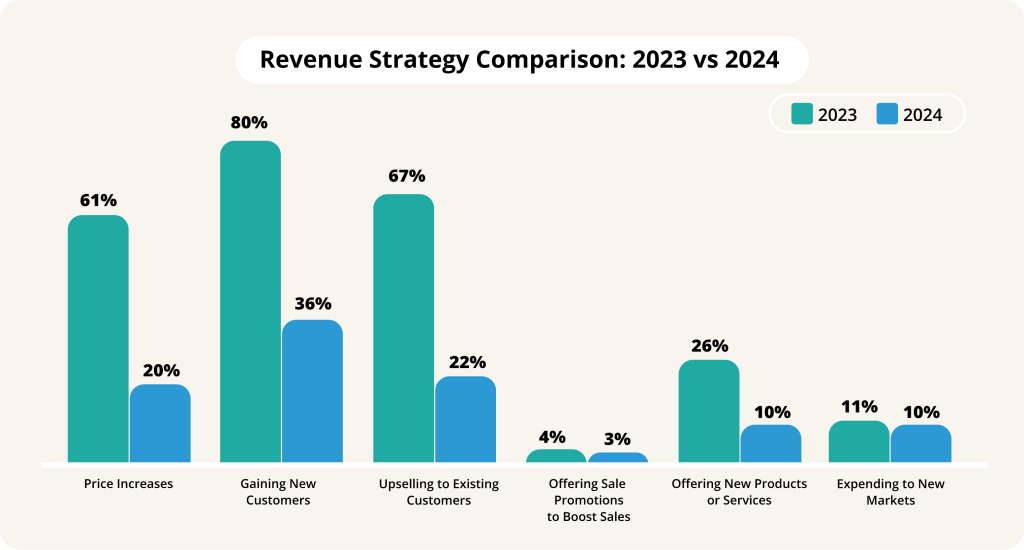
So what does this tell us?
- The quick wins are disappearing.
- Price increases aren’t landing like they used to.
- Upselling is underperforming.
- New services and market expansion are flatlining.
So you can’t just do more—more clients, more services, more hustle—and hope for the best. You’ve got to do the right things.
Let’s take a look at a few of these right things.
Improve Retention and Reduce Churn
If you want to grow revenue without spending a dime on ads or sales calls, you’ve got to start by keeping the clients you already have. Client retention is one of the most underutilized growth strategies for small agencies. It’s not flashy. It’s not loud. But it works.
Here’s the math:
- It costs five times more to acquire a new client than to keep an existing one.
- Long-term clients tend to have larger project scopes, higher trust, and less price sensitivity.
- And agencies that focus on retention see steadier revenue, less churn, and fewer cash flow surprises.
So why aren’t more agencies investing in client retention? Because it’s easy to assume everything’s fine until the client emails to say they’re going in-house.
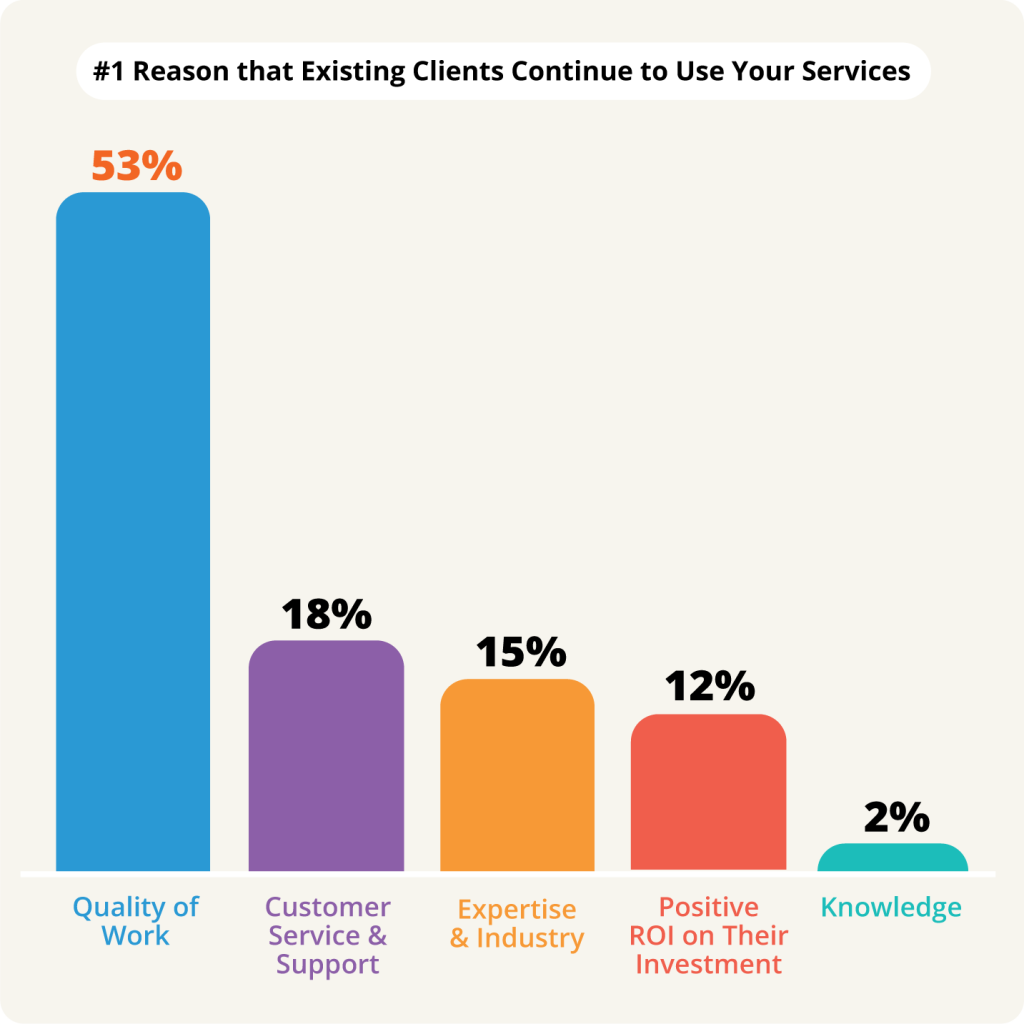
Per the 2025 Industry Report, here’s why clients stick around: WHAT IS THE #1 REASON THAT EXISTING CLIENTS CONTINUE TO USE YOUR SERVICES?
*57% of total agencies answered
And here’s why they leave:
*44% of total agencies answered
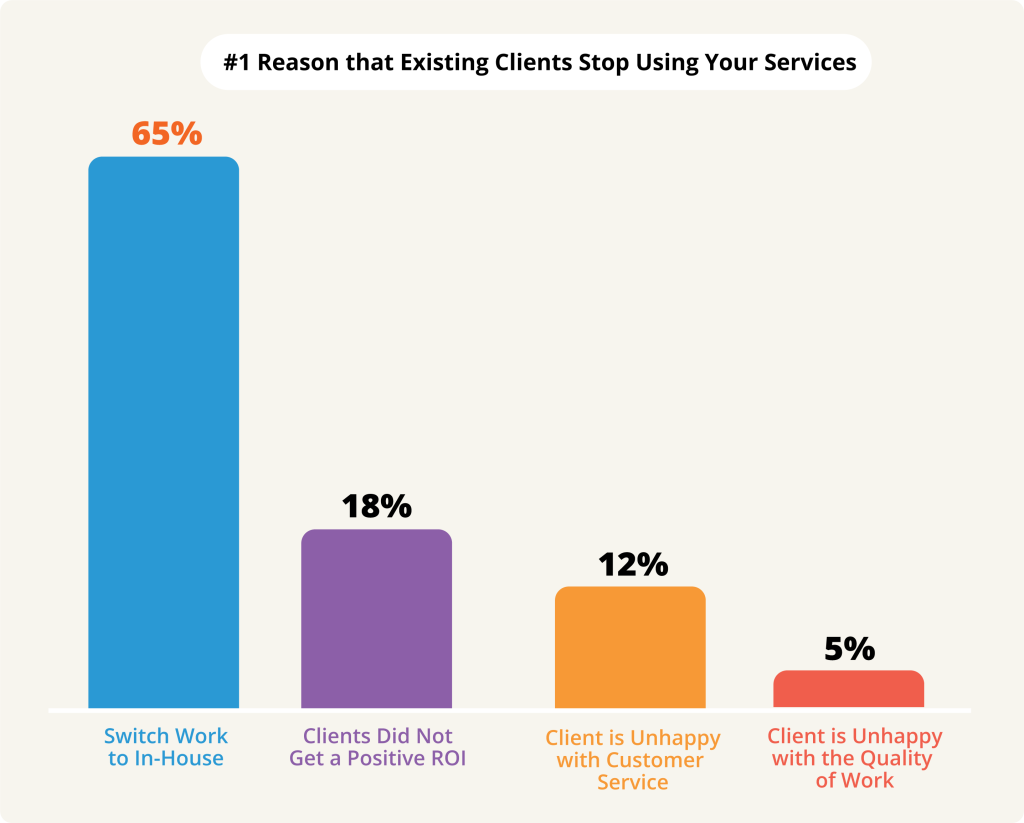
That 65% stat is a beast! We mentioned it before, but that number is huge! Even if your work is good, even if the relationship is decent, you can still lose clients if they think they can get it done cheaper, faster, or easier with an in-house team.
How to Become “Un-Fireable”
So how do you become indispensable? You can’t always stop a client from bringing work in-house, but you can make it a very hard decision for them. Here’s how:
- Deliver Measurable Results: Traffic, leads, sales, brand awareness
- Offer Strategic Value, Not Just Execution: Bring insights. Offer ideas. Think ahead for them.
- Make the Client’s Life Easier: Great communication, fast responses, thoughtful timelines, and proactive problem-solving.
- Ask for Feedback—Early and Often: Simply check-in (“How’s everything going? Are we still aligned?”)
Set Expectations and Reinforce Them
Scope creep and miscommunication are the hidden assassins of client relationships. The 2025 Industry Report showed us that some agencies use a few key techniques to align expectations:
WHAT TECHNIQUES HAVE HELPED YOU BETTER SET/UNDERSTAND CLIENT EXPECTATIONS?
| Having a creative/client brief | 25% |
| Establishing weekly/bi-weekly meetings with the client | 25% |
| Set clear deliverables | 30% |
| Reinforce expectations with reminders | 18% |
| Others | 1% |
When clients know what’s included, what’s not, and what happens next, they’re far less likely to grow frustrated—or bolt.
Watch for Over-Servicing
We said it before, but it’s worth repeating: 79% of agencies are over-servicing clients, often without billing for it.
Instead of saying “yes” to everything:
- Set boundaries in your SOW.
- Flag overages as they happen.
- Build flexible buffers into retainers or offer paid add-ons when things go beyond the agreed scope.
Happy clients are important! But happy, profitable clients? That’s where real growth lives.
Tools & Tech to Support Growth
If your agency is still juggling tasks in Google Sheets, tracking time on sticky notes, or managing projects through email chains, you’re making things so much harder on yourself. And you’re leaving revenue on the table.
Let’s take a look at some helpful tools.
Tools That Make It Easier
Integrated platforms like FunctionFox, Harvest, or Toggl Track let you:
- Track time without friction
- Analyze project profitability in real time
- Set clear scopes and budgets from the start
- Spot scope creep before it eats your margins
- Tie performance back to financial results
The right tools will also give you dashboards and reporting that help you answer questions like:
- Are we making money on this client?
- Is this service line actually profitable?
- Which team members are over capacity?
If you’ve ever thought, “We’re so busy… but we’re not growing,” these are the tools that help you figure out why.
Other Must-Have Tools for Small Agency Growth
Beyond time tracking, here are a few categories of tools that can make or break your ability to scale:
| Category | What It Solves | Popular Tools |
| Project Management | Task tracking, timelines, collaboration | FunctionFox, Asana, ClickUp, Function Point |
| Proposal/Estimates | Faster closing with polished, on-brand quotes | FunctionFox, PandaDoc, Better Proposals, Function Point |
| Invoicing & Expenses | Cash flow, payment tracking, financial oversight | Quickbooks, Freshbooks, Xero, Function Point |
| CRM | Lead nurturing, pipeline management | HubSpot, Pipedrive, Function Point, Function Fox |
| Client Portals | Centralized client communication and file sharing | Function Point, Notion, Monday |
Small, Smart, and Built to Grow
Growing revenue as a small agency means you’ve got to get strategic. As we saw in the FunctionFox 2025 Industry Report, the challenges are real, but so are the opportunities.
Yes, the market is crowded. Yes, clients are moving in-house. But the agencies that are growing right now are the ones that are adaptable and clear on their value.
If you’re not sure where to start, we’re here to help. Book your free demo and start growing smart today!